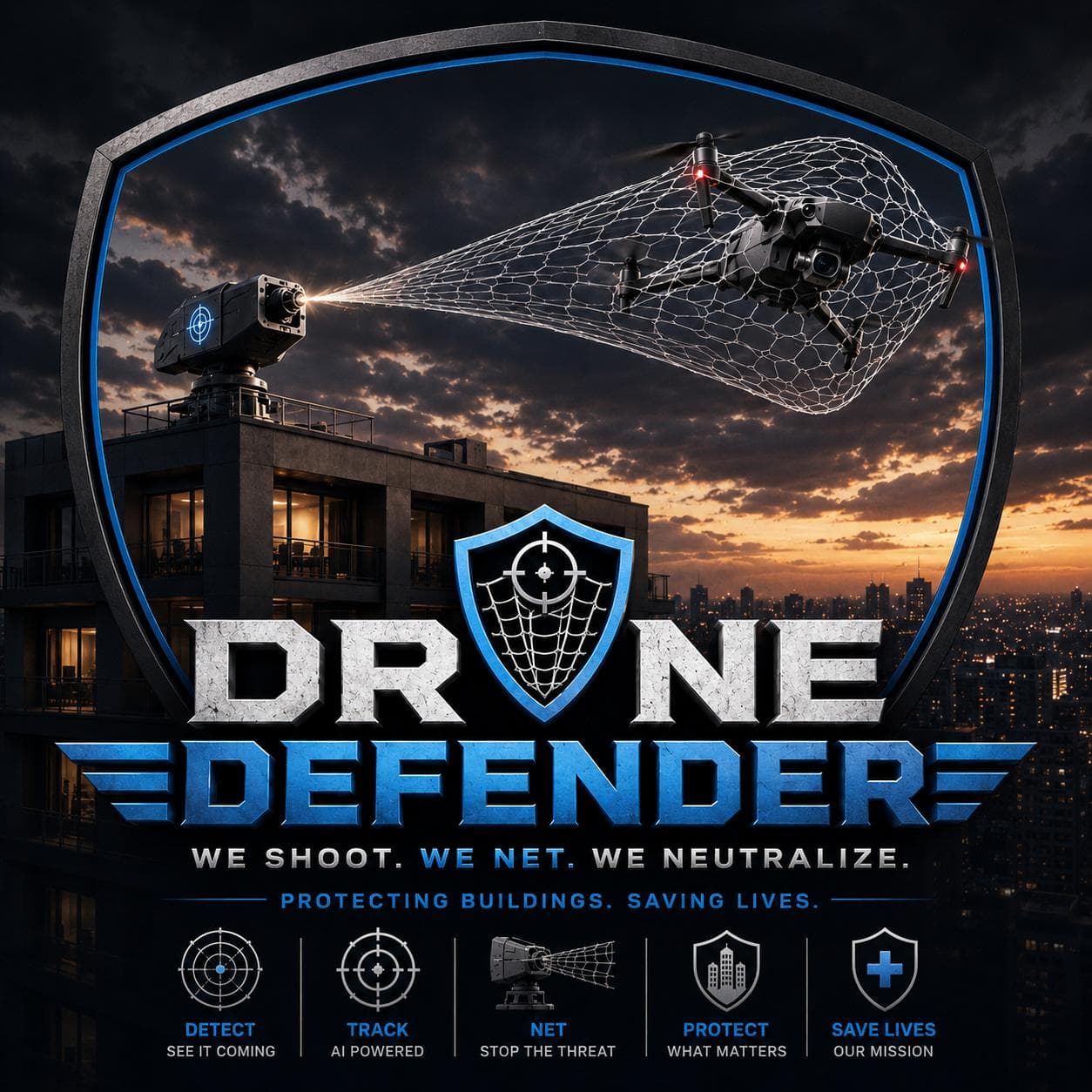
The threat can fly
over the fence.
Drone Defender is a building-focused counter-drone protection architecture designed to detect approaching unmanned aircraft, confirm and assess the track, coordinate building response, and — where legally authorized — support non-explosive physical interception before the aircraft reaches the protected structure.
Persistent awareness of the airspace around the structure
Multi-sensor confirmation before anyone is asked to act
Building response, and authorized mitigation where lawful
Buildings were designed to defend the ground. The threat moved into the air.
Cameras watch doors. Barriers stop vehicles. Access control protects entrances. Conventional security builds strong layers at ground level — but a small unmanned aircraft can approach from above, cross fences and roads, and reach a structure without using any traditional point of entry. Drone Defender adds an aerial security layer built around the protected structure itself.
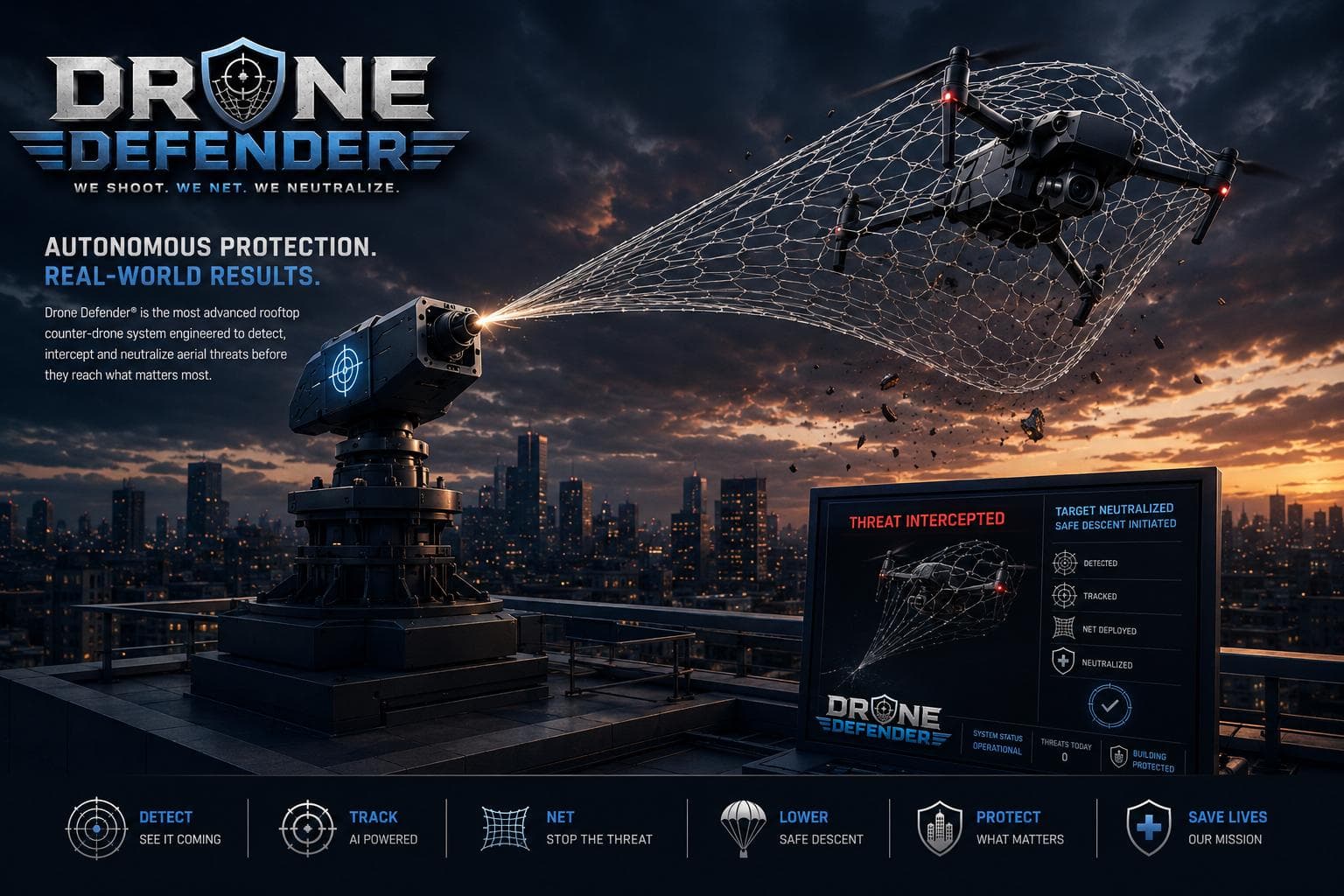
Persistent airspace awareness across the volume that actually matters — the approach corridors and standoff around the protected structure, using compatible detection sensors.
Multi-sensor confirmation and software-assisted assessment, so an operator can tell a probable aircraft from birds, weather and clutter before anyone is asked to act.
Building alerts, security workflows and — for deployments holding the necessary authority — authorized mitigation interfaces, all driven from one operating picture.
From first detection to building protection
Drone Defender is designed as a system of systems. It does not depend on a single camera, radar, algorithm or interceptor — it combines compatible sensing, software, building intelligence, operator workflow and authorized response options into one architecture centred on the structure below.
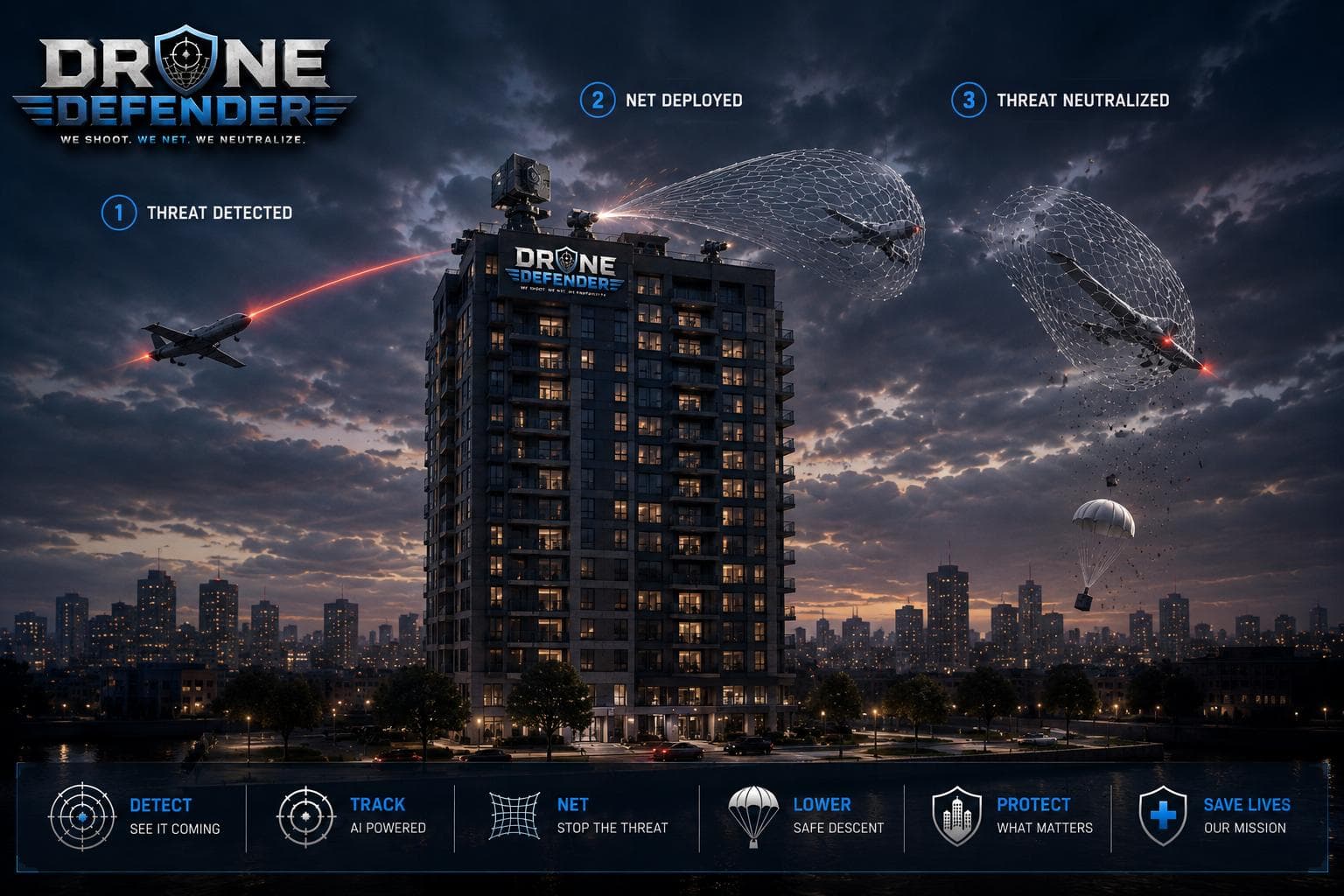
- 01
Detect
Compatible sensors watch the configured airspace around the site and open a track when an airborne object enters a monitored area.
- 02
Confirm
Available observations are correlated into one track, so a single ambiguous return is not mistaken for a confirmed threat.
- 03
Assess
The track is evaluated against the protected structure, configured zones, approach direction and the response policy the customer has authorized.
- 04
Respond
Security personnel receive a common operating picture, and configured building-response workflows can be initiated by the people responsible for them.
- 05Authorized deployments only
Intercept
Where lawful and authorized, the platform can interface with a non-explosive physical-interception layer designed to entangle an incoming aircraft.
- 06
Document
The incident timeline — alerts, sensor state, operator acknowledgements and available imagery — is retained for authorized after-action review.
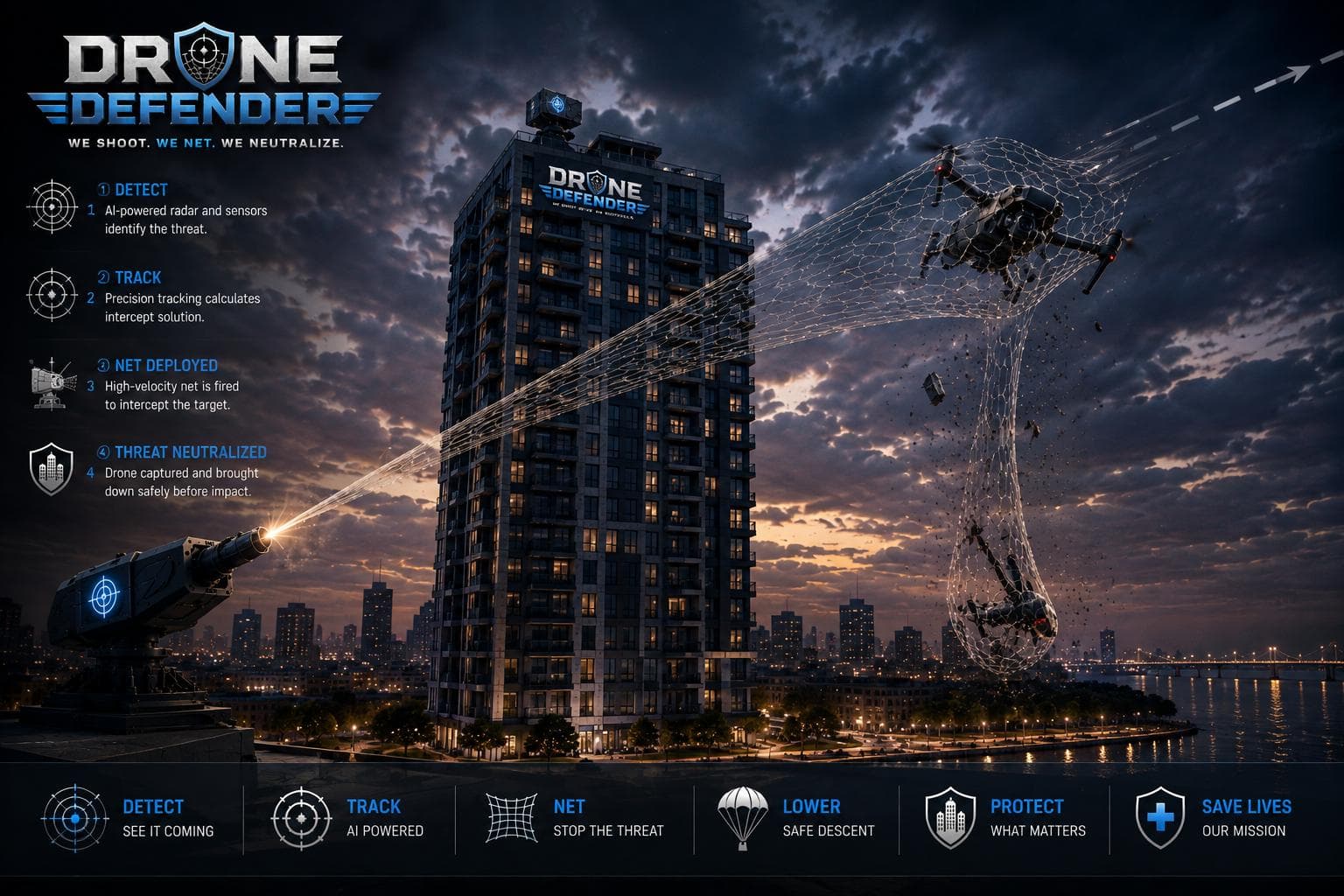
Engineered to stop the aircraft without turning the sky above people into a fragmentation zone.
Electronic countermeasures are not universally effective against every flight architecture, and destructive countermeasures can introduce additional hazards in populated environments. Drone Defender's mitigation philosophy is centred on non-explosive physical interception for authorized deployments, with the objective of disrupting continued flight while reducing avoidable secondary hazards.
No mitigation method eliminates risk. Drone Defender is presented as a layered risk-reduction architecture — not a guarantee of harmless recovery, and not a guarantee against any particular aircraft.
Not a gadget on a roof. A defense architecture built around the building.
Radar-based detection, sensor fusion, AI-assisted assessment, autonomous counter-UAS and net capture all exist in this market already, and we do not claim to have invented any of them. What we are building is the productization of those concepts around occupied structures — the geometry, the people inside, and the security organization that has to act.
Building-first design
The roofline, occupancy, approach corridors, emergency procedures and surrounding risk areas are treated as part of the system, not as context around it.
Layered architecture
Detection, confirmation, software, command-and-control, building response and authorized mitigation are designed to operate as coordinated layers rather than one device.
Modular sensor fusion
Designed to accept compatible radar, electro-optical, infrared, acoustic and other lawful sensor sources instead of depending on a single detection modality.
Human governance
Automation is intended to accelerate detection and decision support while deployment policy preserves authorized human control and oversight where it is required.
Safety-centered response
The architecture prioritizes early warning, risk reduction and controlled response, and avoids fragmentation-producing methods over occupied ground.
Scalable protection
The same platform concept is intended to configure for a single structure, a multi-building campus or a distributed property portfolio.
Command interface
Tracks, zones, alert states, sensor health, event history and authorized response controls in one operating environment.
Integration layer
Documented, secured APIs and event interfaces for approved integrations with physical security, notification and emergency operations platforms.
Cybersecurity posture
Designed for encrypted communications, least-privilege and role-based access, tamper-evident logs, signed software, device identity and secure update.
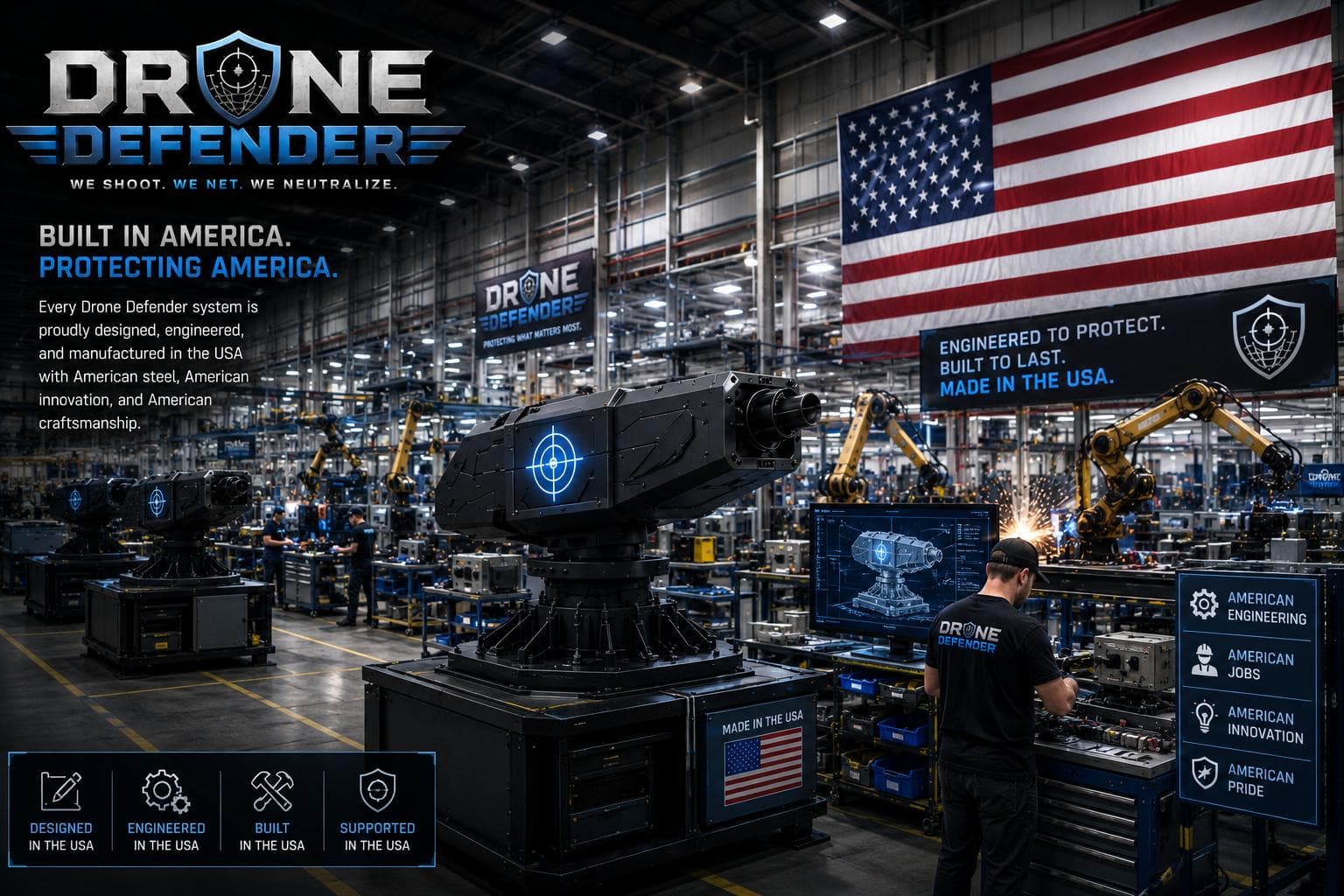
Designed, engineered and built in the United States.
A protection system is only as credible as the shop that produces it. Drone Defender hardware is designed, engineered, manufactured and supported domestically — machined housings, gimbal bases and drive assemblies built on a controlled line, by the same organization that has to stand behind the system in the field.
Systems engineering and industrial design in-house
Mechanical, electrical and software work under one program
Domestic machining and assembly under configuration control
Sustainment, spares and field service from the same organization
Performance figures are not published here. Detection probability, nuisance alert rate, track continuity, alert latency, environmental envelope and interception outcomes will be published only once they are supported by repeatable testing with documented test conditions — and independent validation where it can be obtained.
Sites where the airspace is already part of the security problem.
Critical infrastructure
Layered protection strategies for energy, communications, water, transportation and industrial assets where an aerial approach bypasses every ground-level control.
Public safety & healthcare
Airspace awareness and coordinated response around hospitals and healthcare campuses, where continuity of operations is itself a public-safety function.
Corrections
Awareness of unauthorized aircraft over secure facilities, with event records that support the incident and contraband-interdiction processes already in place.
Events & venues
Temporary and permanent coverage for stadiums, resorts, rooftops and gathering areas, coordinated with the venue's existing security command.
Government & public facilities
A building-focused common operating picture that can be integrated with authorized security procedures and emergency operations.
Corporate campuses & residential towers
Sensor coverage and response workflows scaled across multiple structures, extending security awareness past doors and garages into the air above them.
Powerful defense requires responsible deployment.
Counter-UAS technology operates in a heavily regulated environment. In the United States, federal guidance warns that private entities and many state and local entities may lack authority to disrupt, damage, destroy, take control of, or otherwise mitigate an unmanned aircraft — and detection technologies can themselves implicate federal surveillance and communications law depending on how they operate. We separate detection and situational awareness from physical mitigation in the product architecture and in how we talk about it.
- 01
Purchasing a system does not confer authority to detect, disrupt, damage, destroy, take control of, or otherwise mitigate an aircraft. Authority is a function of who you are and where you operate.
- 02
Mitigation modules are offered only to customers and deployments that hold the appropriate legal authority. Everyone else is supported with a detection-and-awareness configuration.
- 03
Every deployment requires site-specific legal, aviation, spectrum, safety and insurance review before it goes operational. We expect to be part of that review, not a shortcut around it.
- 04
Concept demonstrations and controlled testing are clearly distinguished from operational authority, and we do not present one as evidence of the other.
- 05
Operational parameters — engagement distances, launch energy, timing, spectrum use, projectile or construction detail — are not published on this website and are not disclosed to unqualified inquiries.
Marketing language is held to what the product can actually be shown to do. Drone Defender is not described anywhere on this site, or by our team, as any of the following:
- “the only net-based counter-drone system”
- “the first autonomous counter-drone system”
- “the only system capable of stopping high-speed drones”
- “guaranteed to stop any drone”
- “legal for private property owners to deploy anywhere in the United States”
- “zero collateral risk”
Where a capability is still in development we say “designed to,” “intended to” or “the architecture supports.” Those words are deliberate. They will be replaced with validated claims — and a link to the test methodology — only once controlled testing supports them.
Your perimeter should include the sky.
Tell us what you are protecting. We evaluate the structure, the surrounding environment, the security architecture already in place, sensing requirements, integration needs, and your organization's legal and operational authority — and only then recommend a configuration.
Program & procurement line
Reaches the assessment desk. Keep the conversation general — no site layouts, schedules or sensitive security detail.
207-947-1999Mailing address
Contracts, purchase orders and written correspondence. Not a public walk-in facility; demonstrations are scheduled in advance.
PO Box 52, Detroit, ME 04929
Inquiries from government, defense, law enforcement, critical infrastructure and commercial operators are routed to the same desk. Please identify your organization type so the right people respond.